



The Bitcoin mining difficulty has surged to a new all-time high, even as the crypto market faces fresh volatility following weak U.S. job data.
The latest jump underscores how competitive the mining sector has become, raising questions about profitability, decentralization, and the long-term sustainability of the industry.
Bitcoin Mining Difficulty Climbs to New Heights
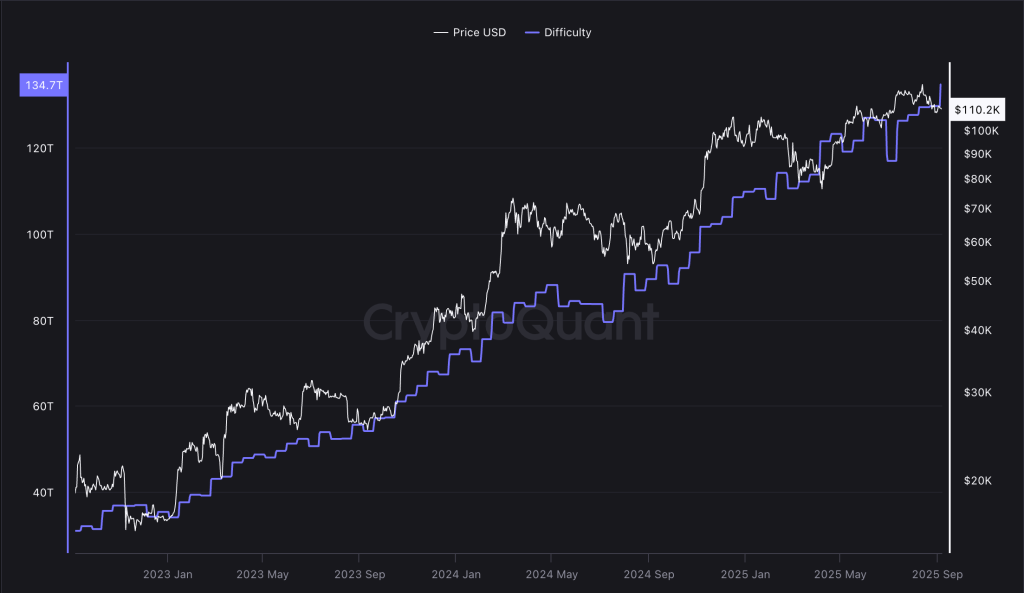
On September 6, the Bitcoin mining difficulty reached a record 134.7 trillion. Mining difficulty is a measure of how computationally hard it is to add a new block to the blockchain. A higher reading means miners must commit more computing power, and electricity, to secure rewards.
Interestingly, while the difficulty hit new highs, the network’s hashrate has dipped. According to CryptoQuant, Bitcoin’s hashrate has fallen to 967 billion hashes per second, down from an all-time high above 1 trillion in August. This divergence between climbing difficulty and declining hashrate reflects the mounting operational pressure on miners.
Rising Costs and Centralization Pressures
As mining difficulty climbs, the cost of competing on the Bitcoin network grows steeper. Mining firms must invest in advanced rigs, higher energy capacity, and expansive infrastructure to remain competitive. Smaller players face shrinking margins, often forcing them out of the market.
This dynamic raises centralization concerns. Larger corporations and well-capitalized pools increasingly dominate, concentrating hashing power in fewer hands. While Bitcoin was designed as a decentralized system, growing entry barriers mean the ecosystem may tilt toward centralization unless innovation or regulatory intervention shifts the balance.
Industry analysts warn that such concentration could threaten Bitcoin’s resilience to attacks or manipulation if mining power becomes too clustered. For now, however, the network remains secure as overall hashrate levels are still historically high despite the recent dip.
Rare Wins for Solo Bitcoin Miners
Despite industry consolidation, solo miners are still scoring surprising victories. In July and August, three independent miners successfully mined blocks on the Bitcoin network, each earning the 3.125 BTC block reward, worth more than $340,000 at current prices.
These wins are extremely rare given the sheer scale of corporate mining pools, but they highlight that smaller players can still participate meaningfully, especially through platforms like Solo CK Pool. Such events also serve as symbolic reminders of Bitcoin’s decentralized roots, even as large-scale miners dominate the landscape.
Why Mining Difficulty Matters
The record-high Bitcoin mining difficulty has implications far beyond the mining community. For investors, it signals rising miner confidence in Bitcoin’s long-term value, since miners are still expanding operations despite higher costs and weaker BTC prices. Historically, spikes in difficulty often precede bullish moves, as they indicate strong conviction and capital investment in the network.
At the same time, profitability pressures are real. With difficulty soaring and Bitcoin trading around $111,100, miners operating on thin margins could face shutdowns if electricity costs remain high or if BTC dips further. The upcoming halving in 2028, which will cut block rewards in half, adds another layer of complexity to long-term profitability models.
The Bigger Picture
he steady rise in Bitcoin mining difficulty demonstrates the network’s growing security and resilience. Every new block requires more computing effort, making it harder for malicious actors to attack the system. Yet this security comes with trade-offs, particularly the risk of centralization as mining becomes prohibitively expensive for smaller players.
For now, Bitcoin’s ecosystem reflects a delicate balance: massive institutions are driving hashrate growth and securing the chain, while solo miners occasionally break through to remind the market of Bitcoin’s open-access ethos. Whether this balance can hold as difficulty and costs rise will be one of the defining questions for the next era of Bitcoin mining.
At press time, Bitcoin trades at $111,100, down 1.6% from its Friday high of $113,000.
