


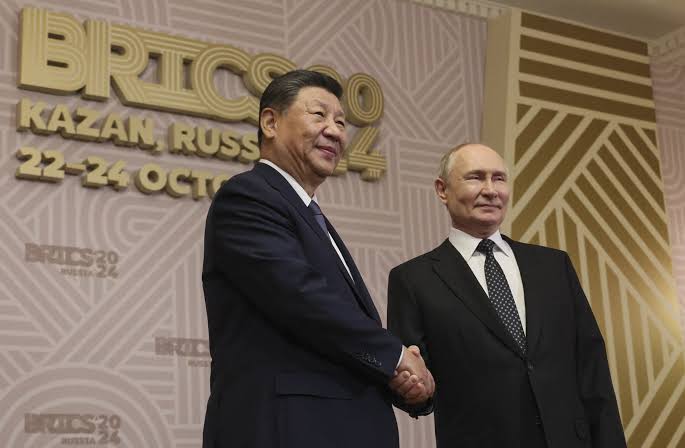
Russia pushes BRICS trade independence as President Vladimir Putin moves to clarify the country’s stance on de-dollarization, rejecting claims that the bloc’s strategy targets the U.S. dollar.
Speaking at the Valdai Discussion Club in Sochi on October 3, Putin emphasized that the BRICS alliance is focused on “cooperation, not confrontation,” even as Russia pushes BRICS partners toward self-sufficient trade systems.
“We do not hold any anti-dollar campaign, anti-dollar policy. Not at all,” Putin said.“We are simply prevented from paying in dollars. What should we do? We pay in national currencies.
“The statement marks the latest effort by Moscow to distance itself from accusations of economic warfare, insisting that Russia pushes BRICS toward trade realignment only out of necessity. The bloc’s growing focus on local-currency settlements, digital payments, and shared infrastructure is seen as a response to sanctions, not an act of defiance.
BRICS Moves Beyond the Dollar
As Russia pushes BRICS policy reforms, the group, comprising Brazil, Russia, India, China, South Africa, and new members including Saudi Arabia and Iran, continues to expand its non-dollar trading networks. The Russian central bank recently revealed that more than 80% of trade with BRICS members is now settled in national currencies such as the yuan, rupee, and ruble.
The shift has accelerated since Western restrictions limited Russia’s access to the global dollar payment system, forcing Moscow to pivot toward alternative mechanisms. Economists see this as a significant milestone in the bloc’s long-term vision of financial independence.
“This is not rebellion; it’s realignment,” said Moscow-based analyst Tatiana Orlova. “As Russia pushes BRICS to adopt shared payment platforms, the group is testing what a multipolar economy actually looks like in practice.”
Market Response and Economic Implications
Financial markets reacted cautiously to Putin’s comments. The Russian ruble strengthened slightly against the dollar, while the Chinese yuan and Indian rupee saw modest increases in offshore volume. Analysts suggest that investor sentiment may continue to improve if Russia pushes BRICS trade partnerships toward tangible digital payment systems and clearing mechanisms.
Still, risks remain. Former IMF chief economist Gita Gopinath warned that diversifying away from the dollar introduces new vulnerabilities:
“Local-currency trade is only as strong as the systems supporting it. Russia pushes BRICS to reduce dollar reliance, but long-term success depends on liquidity, infrastructure, and trust.”
Digital Assets and the BRICS Strategy
As Russia pushes BRICS economic independence, the discussion increasingly intersects with the crypto sector. Russian officials have backed the creation of a blockchain-powered settlement network linking BRICS nations, a system that could use state-backed digital currencies or even stablecoins to streamline cross-border trade.
Insiders suggest that these talks build on China’s digital yuan infrastructure, while Brazil and South Africa have expressed interest in exploring decentralized financial tools for clearing international transactions. If successful, the initiative could position BRICS as a leader in real-world crypto and fintech adoption.
Not a Revolt, But a Redirection
Putin’s remarks at the Valdai forum underline that Russia pushes BRICS not as an alternative empire, but as an evolving coalition seeking economic balance. The president reiterated that BRICS is “not against anyone” and “for fair cooperation and mutual respect.”
As Russia pushes BRICS trade independence further, the global financial order continues to adapt. With new digital systems, local-currency settlements, and policy cooperation on the horizon, the movement represents less of an anti-dollar revolution, and more of a pragmatic step toward a diversified, multipolar economy.
