


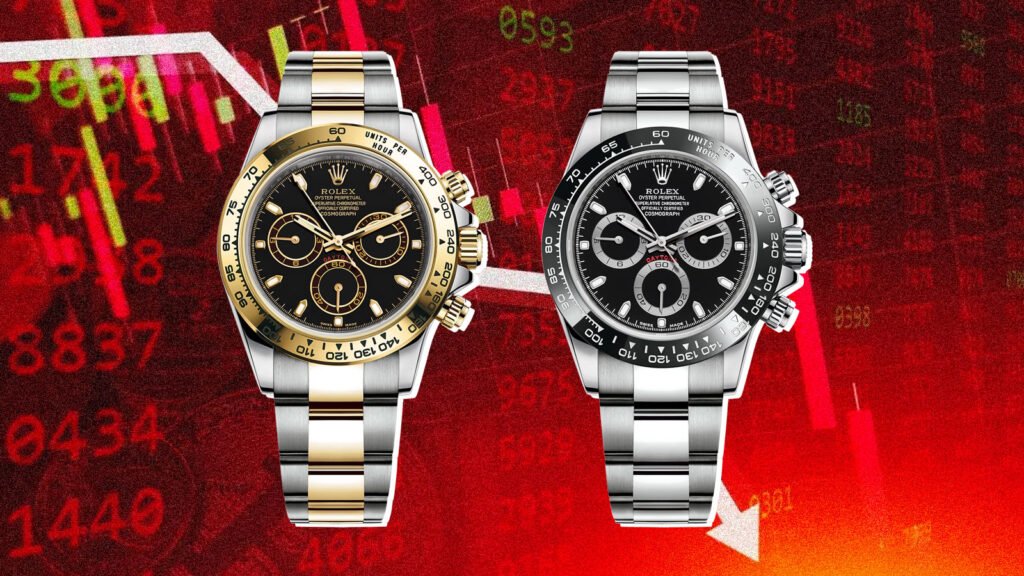
Bitcoin’s price surge has sparked optimism among crypto enthusiasts, but it also contrasts with the economic downturn reflected by the decline in second-hand Rolex watches. The article explores the factors behind Bitcoin’s rise and its challenges in terms of utility, sustainability, and impact.
The leading cryptocurrency has been on a remarkable rally, reaching $44,000 on December 7, 2023. The price spike was fueled by a viral leak of the Grand Theft Auto VI trailer, which featured a “BUY BTC” logo, creating a buzz in the crypto market.
However, while Bitcoin enthusiasts celebrate the new milestone, a different story unfolds in the luxury goods sector, where the average price of second-hand Rolex watches has dropped by 15% since 2022. This phenomenon dubbed the “Rolex recession,” signals a broader economic slowdown that challenges the notion that Bitcoin thrives in all market conditions.
Bitcoin: A Glorified Pet Rock or a Digital Gold?
Coinbase CEO Brian Armstrong recently praised Bitcoin as “key” to the West’s future, citing its potential to foster innovation and financial inclusion. However, despite the optimistic outlook, Bitcoin still lacks a clear use case that justifies its value.
According to a Bloomberg report, Bitcoin is a “glorified pet rock,” yet it is still perceived as a speculative blend of “gold and NASDAQ startup.”
However, unlike gold, which has industrial and aesthetic applications, or startups, which offer products and services, Bitcoin’s utility is limited by its volatility, scalability, and accessibility.
Moreover, Bitcoin’s price is largely driven by sentiment and speculation rather than fundamentals or demand. As the report notes, Bitcoin’s appeal is based on the expectation of substantial returns through hoarding and trading rather than on its usefulness as a medium of exchange or a store of value.
This makes Bitcoin vulnerable to market fluctuations, regulatory uncertainties, and technological disruptions.
Rolex Recession: A Sign of Economic Distress
While Bitcoin’s price soars, the Rolex recession reveals a different picture of the economic situation.
The decline in the average price of second-hand Rolex watches, which are considered as a status symbol and a hedge against inflation, indicates a reduced demand for speculative assets and luxury goods.
According to the report, the Rolex recession reflects the impact of the COVID-19 pandemic, the supply chain disruptions, and the rising inflation on consumer spending and confidence.
The report also draws parallels between the cryptocurrency market and the luxury goods market, suggesting that both are driven by similar psychological factors, such as scarcity, exclusivity, and social signaling.
However, the report warns that both markets are also prone to bubbles and crashes, as they depend on the perception of value rather than the intrinsic value of the assets.
| Year | Average Price of Second-Hand Rolex Watches | Cryptocurrency Market Index |
|---|---|---|
| 2018 | $8,500 | Bullish market growth |
| 2019 | $9,000 | Bearish market growth |
| 2020 | $7,500 | Bearish market growth |
| 2021 | $6,000 | Bullish market growth |
| 2022 | $5,500 | Bearish market growth |
Bitcoin’s Historical Ties and Future Implications
The article also navigates through the intricacies of Bitcoin’s allure, emphasizing its historical ties to central bank policies and monetary easing. It questions the sustainability of Bitcoin’s surge in the absence of significant monetary expansion, as it did in the aftermath of the 2008 financial crisis and the 2020 pandemic.
The article also raises pertinent questions about the environmental cost and societal impact of Bitcoin, urging readers to consider the broader implications beyond the digital realm.
It cites the example of the high energy consumption and carbon footprint of Bitcoin mining, which has been criticized by environmentalists and regulators. It also mentions the potential use of Bitcoin for illicit activities, such as money laundering, cybercrime, and terrorism financing.
The article concludes by presenting a complex and nuanced picture of Bitcoin’s value proposition, highlighting the trade-offs and uncertainties involved in investing in virtual assets.
In this complex dance between Bitcoin’s ascent and the Rolex recession’s economic reality, investors find themselves at a crossroads, contemplating the true value of virtual assets in a world grappling with both financial uncertainties and environmental imperatives.
