



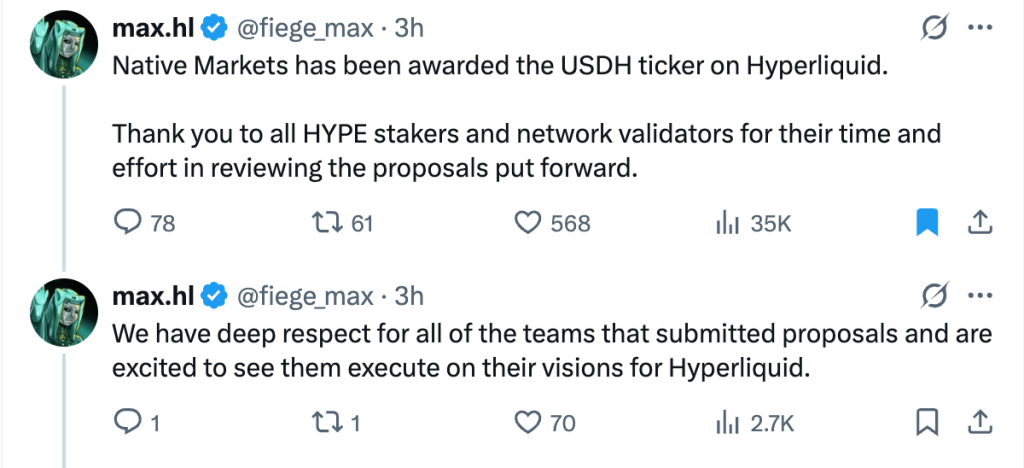
The Hyperliquid USDH stablecoin race has reached its conclusion, with Native Markets officially claiming the coveted ticker after a heated and highly scrutinized bidding process.
The decision, finalized through a community vote, marks a defining moment for Hyperliquid’s growing ecosystem, but not without sparking backlash from industry leaders.
Native Markets Wins the Hyperliquid USDH Stablecoin Bid
Native Markets, co-founded by early Hyperliquid advocate Max Fiege, confirmed its win on Sunday. The team will now deploy the first Hyperliquid Improvement Proposal (HIP) for USDH and launch the ERC-20 version of the stablecoin.
The rollout begins with capped mint and redeem transactions of $800, followed by the opening of the USDH/USDC spot order book and uncapped minting. This staged deployment is aimed at ensuring liquidity, stability, and security before scaling.
On prediction market Polymarket, Native Markets’ odds of success spiked to over 99% after synthetic stablecoin issuer Ethena withdrew from the competition. That left Native Markets as the clear frontrunner, securing validator and community support.
Controversy Over the Selection Process
While the victory cements Native Markets’ role in the Hyperliquid USDH stablecoin future, critics argue the process lacked transparency.
Haseeb Qureshi, managing partner at Dragonfly, called the outcome “a bit of a farce,” alleging that validators showed no genuine interest in alternative bids. He suggested a backroom deal may have predetermined the winner.
Other observers echoed similar concerns, questioning how a relatively new player could outpace established firms such as Paxos, which had pledged to direct 95% of reserve yields into HYPE token buybacks, or Agora, which offered to share 100% of net revenue with the ecosystem.
Stablecoin Commoditization Sparks Debate
The Hyperliquid USDH stablecoin saga also sparked broader reflections on the future of stablecoins. Mert Mumtaz, CEO of Helius, suggested that stablecoins are increasingly being commoditized.
According to Mumtaz, exchanges may eventually abstract stablecoins entirely, showing only “USD” to users on the front end while managing conversions between multiple issuers in the backend. If true, the identity of which team controls USDH may matter less in the long run than the liquidity and reliability it delivers.
What’s Next for Hyperliquid and USDH?
Hyperliquid, which already dominates decentralized perpetuals with over $5.9 billion in reserves and nearly 70% market share in its sector, now has its first native stablecoin firmly in motion.
The Hyperliquid USDH stablecoin is designed to anchor the ecosystem, reduce reliance on Circle’s USDC, and fuel deeper integrations with DeFi protocols. For Native Markets, the challenge will be to prove that it can manage the ticker responsibly while delivering stability, compliance, and long-term value to the Hyperliquid community.
Despite the criticism, the win demonstrates how Hyperliquid’s governance model allows emerging players to rise to prominenc, whether by community conviction, validator alignment, or sheer market dynamics.
For now, one thing is clear: the Hyperliquid USDH stablecoin has arrived, and all eyes are on how Native Markets will shape its future.
